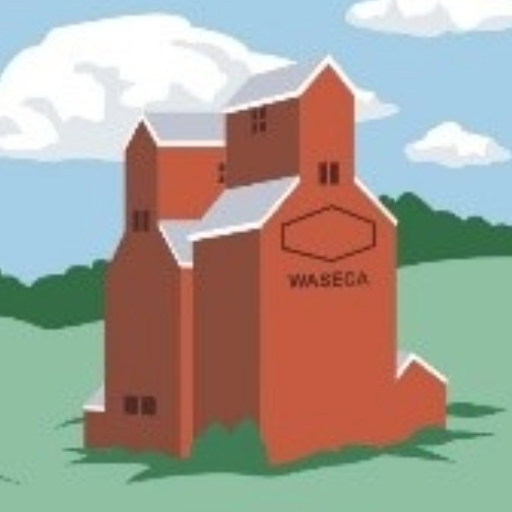

Waseca did not come into existence until the Canadian Northern Railway was built in the year 1905. It is located on a site which is north of what was at one time known as Number 3 Lake, a body of water which covered roughly 225 acres. Bands of Indians used the site, beside the lake, as a camping spot as they travelled through following the buffalo or travelling from place to place. It is believed that the word Waseca (Wasekan) means “camp by the bright water” as this body of water could be seen by the Indians for some distance from whichever direction they came. Due to frequent prairie fires there were no trees to impede their view, also Waseca is 2106 ft. above sea level and the surrounding terrain is higher Shuler’s Hill (three miles southeast) being 2250 ft. above sea level.
From the mid 1870’s surveyors and settlers frequently travelled through the township and the quarter of land on which Waseca is located. In 1876 the first cross-country telegraph line was built and passed through the township from the southeast corner to the northwest corner. From then on Red River carts, travelling from Winnipeg to Edmonton, followed the line. This trail was on the main stream of traffic being used by surveyors, the Northwest Mounted Police, freighters, and settlers.
The first settlers in the township were Robert Lesley, on the southeast quarter of section 14, and Frank Harriet on the northeast quarter of section 24. They came to the area in 1897, then filed on homesteads in 1902 receiving their patents in 1906 and 1907. The Barr Colonists arrived in 1903 and passed through on the trail on their way from Saskatoon to Lloydminster. The Tallant family were the only Barr Colonists to homestead in the area covered by this history book. Other parties of settlers passed through and some stayed to settle in the area.
The quarter, N.E. 32-47-24, on which Waseca is located was purchased by the Canadian Northern Railroad from John D. McKerchar in 1905, the townsite was surveyed and the name Waseca was chosen by John McKerchar.
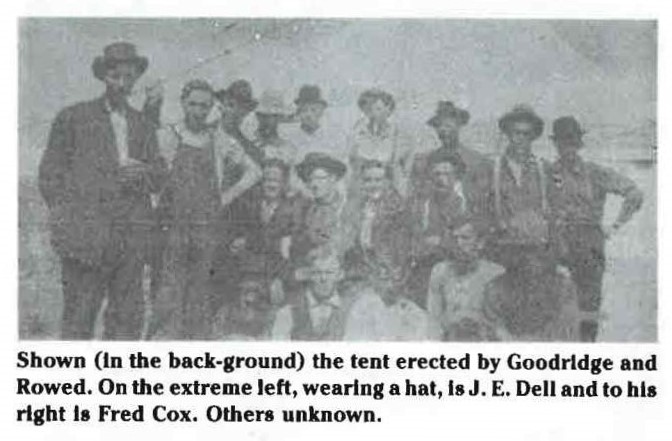
When William Goodridge and Henry Rowed arrived in June, 1906 there was only a shed which served as a shelter for people waiting to take the train. They erected a tent and proceeded to have the first store built.
Although Waseca was only meant to be a siding, it became a trading centre for the area and remained as such until all weather roads made it possible for people to do their trading in larger centres.
In 1911 the population of Waseca was 41; 1921 – 106; 1931 – 122; 1941 – 123; 1951 – 112; 1956 – 132; 1961 – 103; 1971 – 115 and 1983 – 170.
Today although Waseca has completely changed physically and very few of its earlier residents remain, the spirit of friendliness and survival prevails as it did in the beginning.
The problems which faced the residents in pioneer days were altogether different than the ones with which the present residents are confronted. It was the spirit of the pioneers of the area that brought the village into existence and the more recent and present residents, endowed with the same spirit, have kept it a pleasant place to live.
*Page 3 of Waseca Echoes (1984).

 Village of Waseca